The Convoy Forming

Nobody recruits a convoy. Nobody sells one. It becomes visible at the moment enough people who were already heading the same direction finally recognize each other on the road.

Share
The Convoy Forming
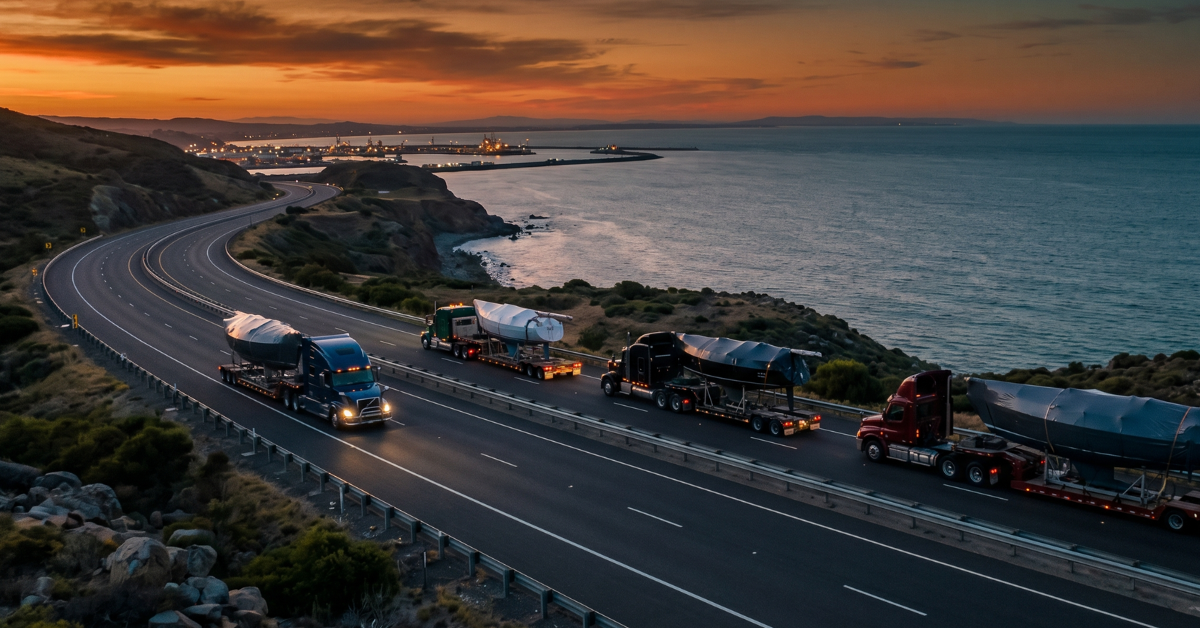
Three semi-trucks hauling covered boats in convoy along a coastal highway at dusk, the road curving toward a harbor lit against a deep orange and teal sunset sky — DSL Life

You don't see a convoy form. That's the thing nobody tells you.

You see it after. You're already in it, already running at speed with trucks ahead and behind you, the load balanced and the miles moving, and at some point you realize that nobody called a meeting to make this happen. Nobody sent a memo. Nobody recruited the lead truck. The convoy became visible to itself somewhere on the highway between one place and the next — and by the time anyone named what it was, it had already been a convoy for miles.

I've been thinking about why that matters. Not as a piece of trucking lore, but as a structural observation about how the right people find each other — and why the process looks like nothing is happening until it suddenly looks like everything is.


There is a version of building an audience that is, at its core, a sales problem. You identify a target. You construct an offer. You run the acquisition mechanics. You optimize for conversion. The people who arrive are people who responded to a mechanism you designed and deployed.

That is one kind of gathering.

What happens at DSL is something different in its architecture, and the difference is not cosmetic. The people who find this publication are not responding to a funnel. They are not being intercepted mid-scroll by something engineered to stop them. They are arriving because they were already heading this direction before they knew this place existed.

That sounds like something you tell yourself when the numbers are still small.

How many convoys have you seen form from the front? How many did you only recognize once you were already in the middle of one?


The convoy on a long highway has a structure that looks accidental from the outside and isn't. The lead truck sets the pace. Not because anyone elected it, but because it was already moving and others fell in behind. The tail end catches up because the road ahead looks cleaner with someone running point. The people in the middle — the ones who benefit from both the lead and the tail without knowing either driver by name — they found their position the same way. They were on the same road, heading the same direction, and the convoy became the path of least resistance.

Nobody recruited them into it. The road did.

This is how DSL Life works, or how it is supposed to work, and the distinction from the conventional audience-building model is not just philosophical — it is operational. When someone finds The Read because they were already thinking about digital sovereignty, already questioning the infrastructure of their professional life, already carrying the restlessness that comes from being excellent inside a structure that belongs to someone else — they don't arrive as a lead that converted. They arrive as someone who was already on the road.

That is a different kind of subscriber. And they compound differently.

What does it mean to build something designed to be found by people who were already looking for it?


The CB radio on a long convoy run has its own economy. Mostly it's quiet. Occasionally someone calls out a bear in the median, a slow patch of traffic two miles ahead, a stretch of construction on the far side of the grade. The information moves in both directions without a dispatcher. The lead truck doesn't own the channel. The tail doesn't wait for permission to transmit. The convoy self-organizes around shared interest in the road conditions ahead, and the result is that everyone runs cleaner than they would alone.

That is the Hammer Lane version of what community actually is.

Not a platform. Not a managed space with scheduled engagement and pinned announcements. A channel where people who are already on the same road share what they're seeing ahead — because that information is genuinely useful, because they've been running alone long enough to know what the Solo Tax feels like, and because the person two trucks up has already navigated the grade they're approaching.

The Harbor is built on that logic. Not as a product feature. As a structural assumption about what sovereign professionals actually need from each other.


The momentum that compounds inside a convoy isn't manufactured. It is the natural result of people who were already heading the same direction finally being close enough to see each other on the road.

Little by little, the right people find this. Not because an algorithm delivered them. Because they were asking the same questions, carrying the same restlessness, navigating the same gap between the life they've been building and the life they can see from where they're standing. They find The Read the way people find everything that has ever genuinely mattered to them — not because they were sold it, but because it was already where they were heading.

And then one of them mentions it to someone else on the same road. And that person mentions it to another. And the shares are not marketing behavior — they are CB traffic. Someone calling ahead about what they found on the other side of the grade.

At some point — not announced, not manufactured — one person joining becomes fifteen in a week. The math doesn't change. The visibility does.

This is not a growth strategy. It is a structural description of how movements form. Not from the front, where someone with a megaphone announces the direction. From the middle, where enough people independently decided to take the same road and eventually recognized each other on it.

The road looks empty until it doesn't.

And by the time you notice the convoy forming around you, you've already been part of it longer than you realized.