
The Feeling Industry
An empty hotel ballroom the morning after an event, rows of chairs left in disarray, confetti and abandoned papers scattered on the floor, one spotlight still lit on an empty stage.

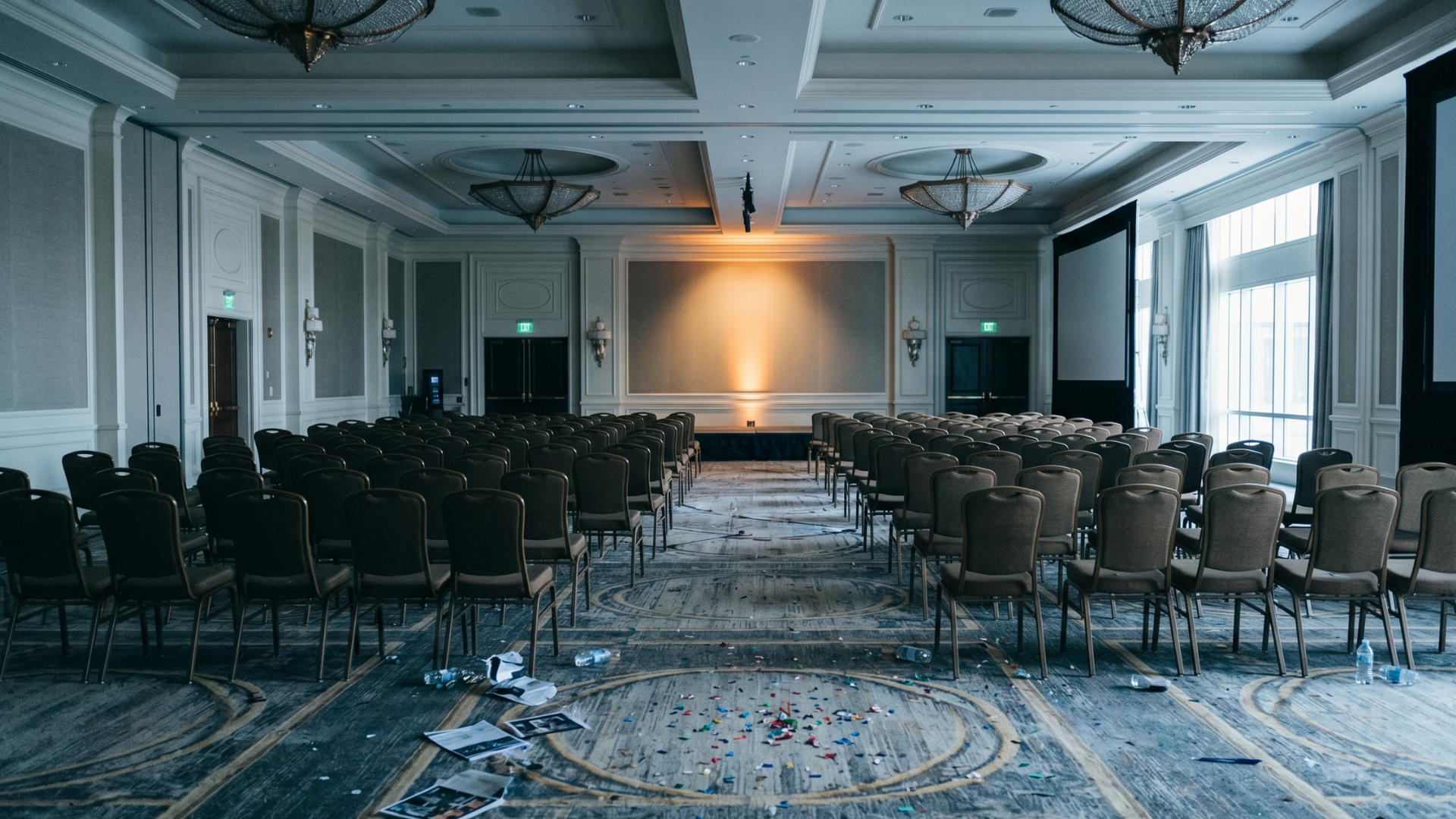
The applause started before the pitch was finished.
That's the detail that stays with you. Not the words — the timing. A room of three hundred people clapping at the promise of a sentence, not its content. The speaker had learned to leave a gap exactly where the emotional payload lands, and the room filled it before he could.
You've been in that room. Maybe not that exact one, but its architecture is everywhere now — hotel ballrooms, Zoom webinars, the back half of a podcast. A speaker stands behind a single word blown up on a screen. Called. Aligned. Activated. The word does no operational work. It does something else entirely: it tells you that the static, ordinary feeling you walked in with was actually a symptom, and the room has the cure.
Here is the structure, named plainly so you can recognize it next time you're sitting inside it. First, the identity hook — you are not just someone with a problem, you are someone who has been called to something larger, and the fact that you haven't gotten there yet isn't a strategy gap, it's a calling deferred. Second, the intensification — the language sharpens around what staying where you are will cost you: purpose unlived, potential wasted, a version of you that's been waiting. Third, the container — a premium offer priced not against deliverables but against transformation itself, sold as the bridge between the identity you've just been told you have and the life that's supposedly attached to it.
None of this is necessarily dishonest. That's what makes it durable.
The room genuinely felt something. The applause was real applause, not performed. People left with their chests a little tighter, their posture a little straighter, convinced something had shifted. And something had — for about as long as the parking lot.
What happens Monday morning?
This is the question the pitch never has to answer, because by Monday you're a customer, and customer success is a different department from sales psychology. You wake up with the feeling mostly intact and the operational reality completely unchanged. Same client roster. Same content calendar, empty. Same uncertainty about where the next ten leads come from. The identity has been confirmed. The infrastructure has not been built. Nobody in that room sold you a system for finding customers on a Tuesday when you don't feel called to anything — they sold you a feeling about Tuesdays in general, delivered with enough intensity that you mistook the feeling for a plan.
This is the trade worth naming honestly: a coach who sells you better execution on a structure you already understand is a different transaction entirely from a coach who sells you a feeling dressed in the vocabulary of strategy. The first is premium pricing for premium support — a fair exchange, even an expensive one. The second is premium pricing for emotional anchoring, wearing a system's clothes. The words sound identical in the room. They function nothing alike six weeks later.
Why does "alignment" do so much work in these pitches? Because it's unfalsifiable. You cannot audit alignment the way you audit a conversion rate. There's no metric for purpose. So when the language of purpose stands in for the language of operations, the seller has found something close to a permanent product — a thing that can never be definitively shown to have failed you, because it was never a claim that could be tested in the first place. A funnel either converts or it doesn't. A community either retains members or it doesn't. Alignment just is, indefinitely, available for reinterpretation whenever the result doesn't show up on schedule.
Call this what it is structurally: a Velvet Cage built entirely from feeling. The walls are soft. The door isn't locked. You could walk out any time — except walking out would mean admitting the feeling wasn't the thing you actually needed, and that admission is expensive in a way the membership fee never was. So you stay, comfortable, unequipped, telling yourself the breakthrough is still loading.
What would the room look like if the energy in it had to survive contact with a spreadsheet?
That's not a rhetorical jab at energy itself. Energy in a room is real, useful, even necessary — momentum has to start somewhere, and a flat room rarely builds anything. The question is whether the energy is the entire product, or whether it's the delivery mechanism for something with bones underneath it. You can tell the difference by what's left twenty minutes after the lights come up. Strategy leaves you with a next action. Feeling, alone, leaves you with a glow and a credit card receipt.
There's a version of credibility that gets built by showing the actual mechanism — the failed first launch, the spreadsheet that didn't balance for eight months, the client roster built one unglamorous referral at a time. And there's a version of credibility that gets borrowed, costume-style, from the appearance of having transcended mechanism altogether — the implication that the speaker is now operating from some plane where tactics aren't necessary anymore, only vision. The first kind of credibility is slow and admits its own ordinary effort. The second kind is faster, and it photographs better, and it cannot be reverse-engineered by the person who just bought it, because there was nothing underneath the photograph to begin with.
You already know which one holds up on a tired Tuesday. The room with the applause wasn't built for Tuesdays. It was built for the night it happened, under lights, with three hundred people confirming each other's certainty in real time. Tuesday is alone, with a laptop, and the feeling has nowhere left to perform.
What does it cost to feel motivated by someone who has nothing operational to hand you when the motivation runs out?