You Can't Sample That Anymore Part Two of "The Algorithm Ate My Rock 'n' Roll"
You had a creative idea. You found the tool. Then the terms of service explained why the 1980s are over. What the collapse of sample culture tells digital entrepreneurs about ownership, leverage, and who gets to create freely.

There's a specific kind of creative itch that doesn't ask permission.
You hear two songs — separated by years, by genre, by context — and something in your brain fires: those belong together. Not as a cover. Not as a tribute. As something new. A collision that produces a third thing neither song could be alone.
That instinct is older than music licensing. It's how culture has always moved.
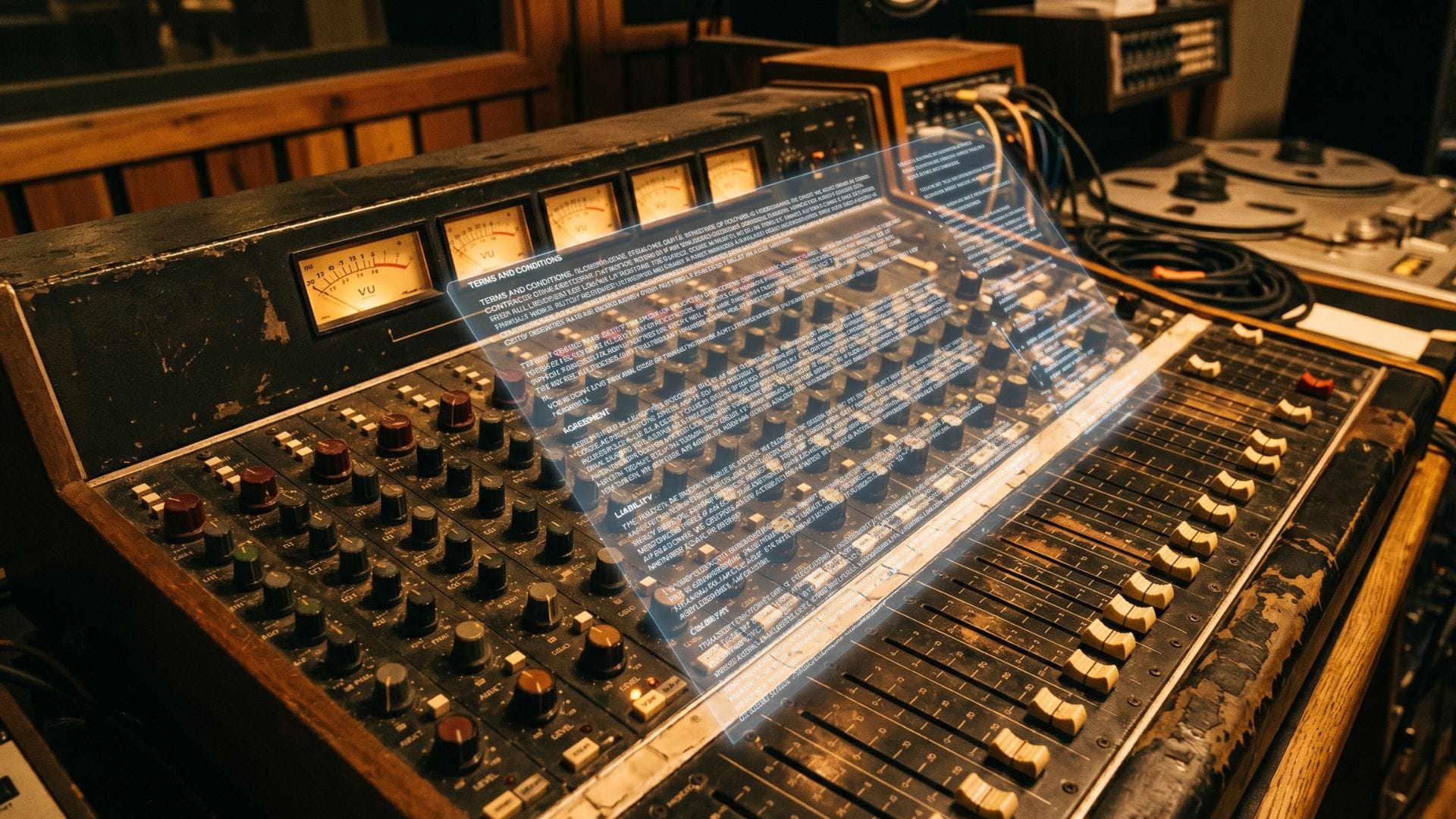
So when I went looking for a tool to scratch that itch — specifically ROX Audio, an AI mixing and mastering platform — I wasn't thinking about lawyers. I was thinking about Frankie Goes to Hollywood's "Relax" bleeding into Pet Shop Boys' "West End Girls." The BPM compatibility. The shared tension. Two songs built from the same coiled, urban energy — one all heat, one all cold — and what a skilled DJ could do with that collision.
What I found instead was a legal wall. A polite, well-written, entirely reasonable legal wall.
ROX's terms are standard for the industry: you must own the rights to anything you upload, or hold explicit permission from whoever does. The tool is yours to use. The liability is yours to carry. If you upload someone else's music without clearance, you're on the hook — not just for ROX's legal costs, but for your own.
That's not ROX being predatory. That's ROX surviving in the current environment.
But it sent me down a rabbit hole, because I remembered a time when this kind of creative experiment was just called Tuesday.
The Beastie Boys built Paul's Boutique from somewhere between 100 and 300 samples — depending on who's counting. The Dust Brothers cleared a significant chunk of them for roughly $250,000 total. Today, that same clearance process would run into the millions. De La Soul's catalog spent decades locked off digital platforms entirely, because their 1989 contracts only cleared those samples for vinyl, cassette, and CD. Streaming didn't exist yet. Nobody thought to ask.
The moment that changed everything? A single 1991 lawsuit. Grand Upright Music v. Warner Bros. Biz Markie sampled Gilbert O'Sullivan without permission. The judge opened his ruling by quoting the Bible. The Golden Era of hip-hop collage — the era where music was dense, referential, conversational — effectively ended in a courtroom that year.
What followed was thirty-five years of legal scar tissue. Content ID filters. Clearance teams. Terms of service designed to push liability as far downstream as possible.
Here's what strikes me about that arc, as someone building in the digital space:
The creative instinct didn't change. The infrastructure around it did.
And this is a pattern worth paying attention to — not just in music, but in every domain where platforms mediate between creators and their audiences. The tool expands. The terms constrain. The liability flows downhill. The people with existing ownership keep their leverage. The people without it negotiate from a much smaller table.
That's not a conspiracy. It's just how systems consolidate over time.
In the first piece in this series, we talked about what happened when radio discovery got centralized — first by the 1996 Telecommunications Act, then by platform algorithms. This is the next layer of the same story. It's not just about what gets heard anymore.
It's about what gets made.
Ownership isn't just a financial concept. It's a creative one. When you own what you make — your original recordings, your own voice, your own stems — you don't need anyone's permission to move. You don't negotiate for the right to exist.
The creative itch is still valid. The tools are genuinely powerful. But the question worth asking before you reach for any of them is the one the music industry learned the hard way:
Who actually owns this?
Explore the full history of how sampling culture got legally dismantled — and what it means for digital creators today — in the original Algorithm Ate My Rock 'n' Roll piece. The conversation continues there.