The Workspace Variable Nobody Audits
Your workspace isn't neutral. The light in the room is running a background process on your biology — and most freedom builders have never thought to check it.

Most location-independent workers spend serious time optimizing the wrong things.
The apps get reviewed. The time zones get managed. The morning routine gets refined until it runs like a system. And yet something still feels off — a low-grade cognitive drag that follows you from city to city, coworking space to café, Airbnb to hotel room. You assume it's the travel. Or the time zone. Or the fact that you haven't quite found your rhythm yet.
It might be the light.
Not in a mystical sense — in a straightforward biological one. Your body runs on a circadian clock that predates every productivity framework ever written. That clock is regulated primarily by light: its spectrum, its timing, and its intensity relative to what your biology expects at a given hour. When those inputs are consistent and well-timed, your metabolism, focus, cortisol curve, and sleep architecture tend to follow. When they aren't — when you're working under blue-heavy overhead fluorescents at 9pm, or starting your day staring into a screen before your eyes have seen natural light — the clock drifts. And a drifting clock is a quiet tax on everything that follows.
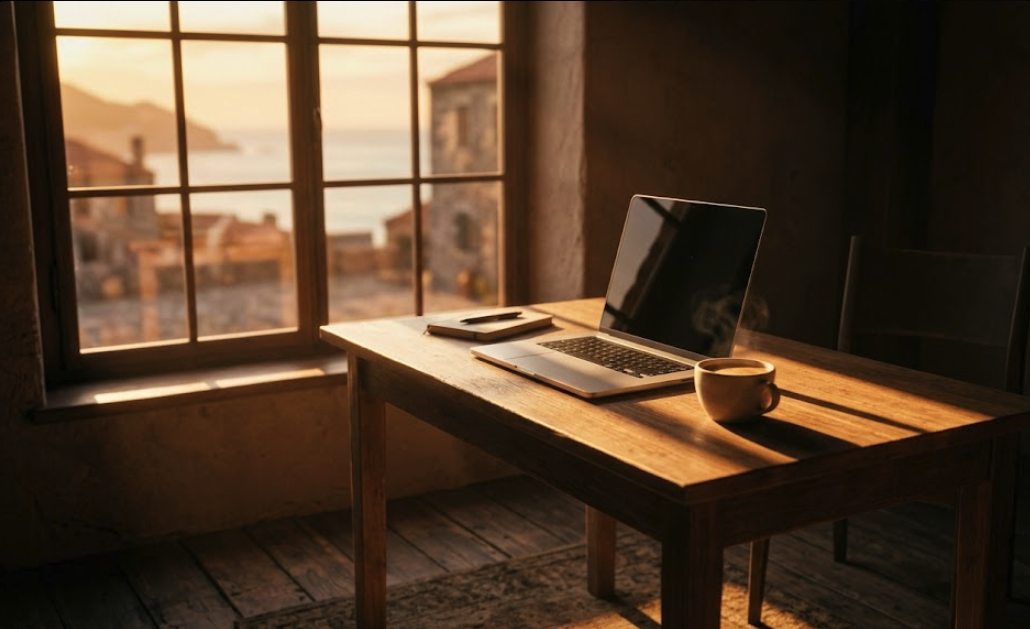
This matters differently for location-independent workers than it does for people in fixed offices. When you control your environment, you carry both the freedom and the responsibility of designing it well. The coworking space that looked great in the photos might be bathed in cool white LEDs that spike alertness at the wrong hours and flatten it when you need it most. The charming café with the exposed brick might have zero natural light past noon. The apartment you booked for a month might have blackout curtains that felt like a luxury until you realized you've been waking up in artificial dark for three weeks.
The audit most freedom builders skip is this: what is the light doing in this space, and when?
A few variables worth examining wherever you land:
Morning light first. Before the screen, before the coffee ritual, before the inbox — natural light signals your system that the day has actually started. Even ten minutes outside, or near a window with real exposure, sets a biological anchor that everything else runs better against. This isn't optimization theater. It's the original circadian input your clock is waiting for.
Color temperature by time of day. Most people know that screens emit blue-heavy light. Fewer think about the overhead lighting in their workspace doing the same thing at 8pm. Warm-toned bulbs in evening environments — or simply dimming and moving away from overhead lighting as the day winds down — supports the hormonal shift your body needs to actually recover overnight. Recovery is where performance gets built. The workspace that doesn't account for evening light is quietly borrowing against tomorrow.
Darkness as a design choice. The flip side of morning light is genuine dark at night. Not dim — dark. Location-independent workers often stay in spaces optimized for Instagram, not sleep. Worth asking before you book: what does this room actually look like at 10pm?
Natural light as a location filter. If you're choosing between two otherwise equivalent cities or spaces, light access is a legitimate productivity variable — not a luxury preference. How many hours of usable daylight? What direction do the windows face? Is outdoor work viable? These questions have real answers that affect real output.
None of this requires a biohacking protocol or a supplement stack. It requires treating your environment as a tool the same way you treat your laptop or your calendar — something worth auditing, adjusting, and taking seriously as part of how the work gets done.
The freedom to work from anywhere is genuinely valuable. The discipline to make anywhere work for you is where that freedom compounds.
This piece draws on emerging research in circadian biology and environmental medicine, including the foundational work of Dr. Robert O. Becker on electromagnetic biology and clinical observations on light's role in metabolic and cognitive function. For the full science, the work of circadian researchers like Satchin Panda and Andrew Huberman offers accessible entry points. The application to freedom-based work environments is original to Rez at Digital Startup Lifestyle.